Table of Contents
ToggleMounting a TV above the fireplace is one of the most popular living room configurations, but pull it off wrong, and you’ll end up with neck strain, overheated electronics, or a visual mess of cables. The challenge isn’t just hanging the television: it’s creating a setup that looks intentional, functions safely, and doesn’t sacrifice comfort. Whether you’re working with a gas fireplace, a traditional hearth, or a modern linear insert, the right approach combines practical engineering with smart design. This guide walks through real-world TV above fireplace ideas, including how to handle fireplace and TV side by side layouts, heat considerations, and the styling choices that make the setup feel like part of the room rather than an afterthought.
Key Takeaways
- Mount your TV 42 to 48 inches off the floor for an 8-foot seating distance to keep your eyes at a neutral angle and avoid neck strain.
- TV over fireplace ideas should account for heat management—measure temperatures above 85°F at the proposed TV location and install heat deflectors or ventilation if needed to prevent electronics damage.
- Use a tilting mount when a fireplace mantel forces higher TV placement, allowing you to angle the screen down for comfortable viewing without a clunky appearance.
- Conceal cables in PVC or fabric conduit running vertically along the fireplace wall, or route them behind built-in cabinetry for a polished, finished look.
- Choose between open styling with floating shelves or integrated built-in cabinetry—both approaches work when paired with proper ventilation gaps to protect electronics from heat buildup.
- Confirm your fireplace clearance meets code (typically 12 inches minimum from gas firebox to combustibles) and consider electric fireplaces as the safest option for mounting directly above.
Mounting Heights and Viewing Comfort
The biggest mistake homeowners make is mounting the TV too high. Many internet guides suggest 55 to 65 inches from the floor to the center of the screen, which works for theaters designed around a 10-foot distance, but living rooms are tighter, and your fireplace complicates the math.
Start by measuring your seating distance. If your couch is 8 feet from the wall, the TV’s center should sit roughly 42 to 48 inches off the floor. This keeps your eyes at a neutral angle, not tilted upward. If you’re 10+ feet away, bump it to 48 to 55 inches. The gold standard: your eye level when sitting should be near the vertical middle of the screen, with a horizontal view angle of no more than 30 degrees up or down.
With a fireplace below, you’ll often have less flexibility. A standard fireplace opening sits 12 to 18 inches above the floor, and a mantel adds another 12 to 48 inches depending on the surround style. If your mantel is at 48 inches, mounting the TV bracket 20 to 30 inches above it puts you in the 68 to 78-inch range, high, but sometimes unavoidable with taller fireplace surrounds. In these cases, a tilting mount is non-negotiable. It lets you angle the screen down slightly without looking clunky.
Measure twice before drilling into studs or a masonry fireplace. Mark your center line with a laser level, then mark the bracket holes. A fixed bracket works for basic rectangular fireplaces with open space above. Tilting and full-motion brackets cost more but give you flexibility if the mounting height isn’t ideal.
Mantel and Surround Design Options
The area around the fireplace, the surround and mantel, sets the visual tone. You have two main directions: open and minimal, or concealed and integrated.
Floating Shelves and Open Styling
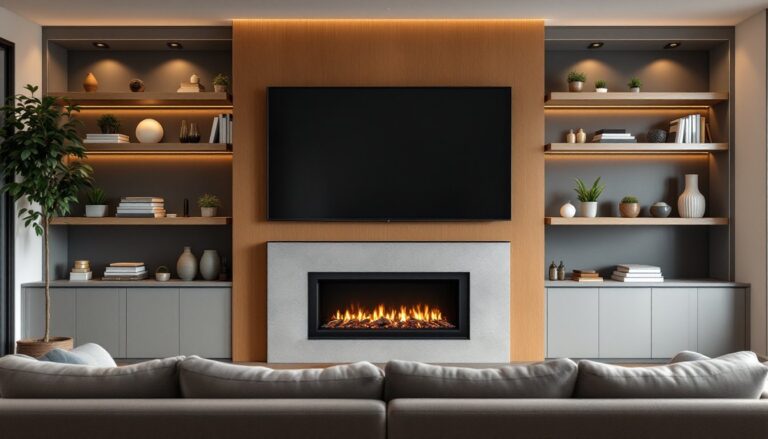
Floating shelves flanking the TV work well if your fireplace surround is tiled, stone, or shiplap. Install 1.5-inch-thick solid wood or reinforced metal shelves on French cleats bolted into wall studs: single-stud mounting fails under the weight of books, plants, or decor items over time. Space them 12 to 18 inches from the TV’s edge, not directly adjacent, this keeps the TV the focal point and leaves room for cable conduit or ventilation. Style with a few books, small plants, and one or two decorative objects per shelf. Too many items make the space feel cluttered: too few make it feel empty.
A modern gas fireplace with a sleek steel or concrete surround pairs especially well with this approach. The fireplace becomes part of a larger composition rather than a frame for the TV. If you go this route, use cord covers or conceal cables in a conduit running behind the mantel or along the upper edge of the surround.
Built-In Cabinetry and Concealment
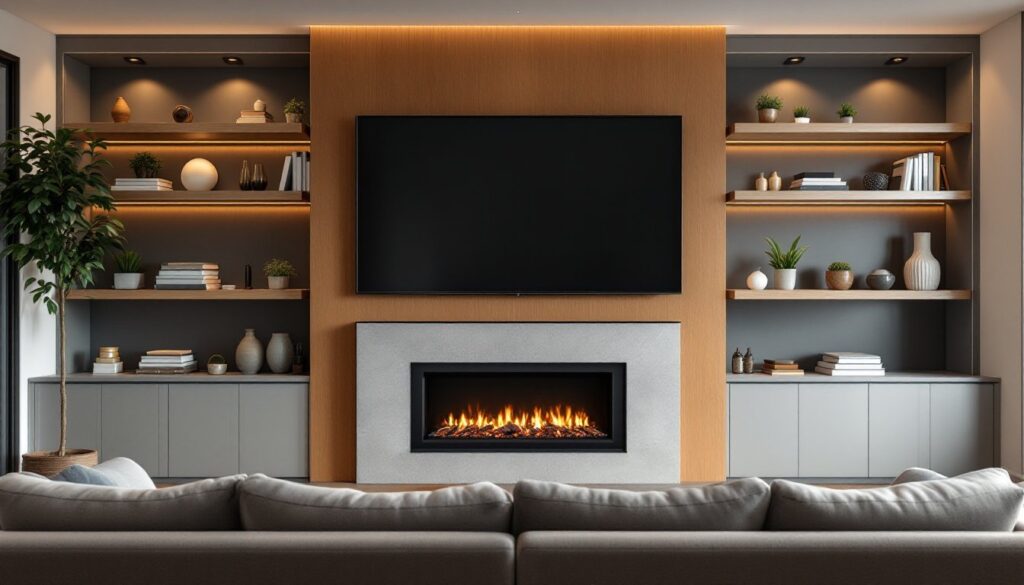
If you want a polished, integrated look, and room for hiding electronics, cables, and media, a built-in cabinet surround is the move. This is carpentry work: frame the fireplace with 1×12 or 2×12 boards, add stile-and-rail cabinet doors or panels, and top it with a solid mantel. The TV sits in a central opening or recessed niche cut into the framing.
Built-ins require precision. Measure the fireplace opening in three spots (top, middle, bottom) because surrounds are rarely perfectly square. Account for door swing, hinge clearance, and electrical outlets inside the cabinet. You’ll want a ventilation gap, usually 4 to 6 inches, behind the TV to prevent heat buildup, especially with gas fireplaces. Drill weep holes or use slatted backing to ensure air circulation.
Cables run through the cabinet wall behind the TV, exiting near your TV stand or through a trim ring to the electronics hidden inside. This approach works beautifully for living room fireplace decor with TV above because the cabinetry becomes the star: the TV is almost incidental. Costs run $2,000 to $5,000 for materials if you DIY: professional cabinet makers charge $4,000 to $8,000+ depending on finish and detail.
Heat Management and TV Safety
Here’s the hard truth: TVs and fireplaces are enemies. Modern flat-screen TVs have electronics crammed into a chassis with limited cooling. Heat above 95°F can degrade the display, warp plastic components, and kill the backlight. Wood-burning fireplaces and gas inserts both throw serious heat upward, especially if the fireplace sits recessed into the wall.
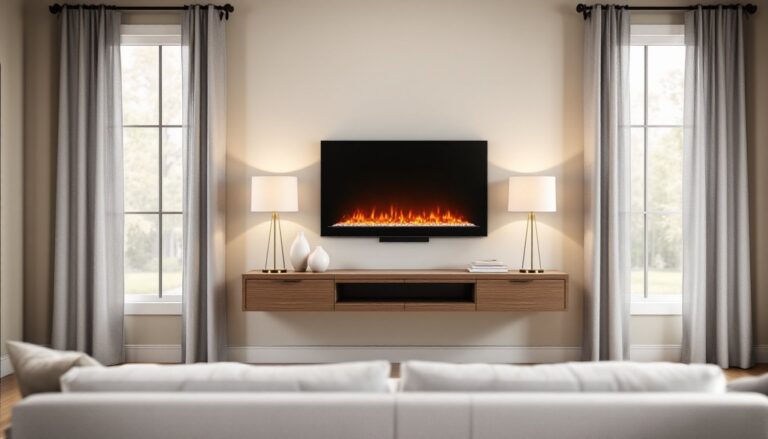
First, confirm your fireplace clearance. Most code requires a minimum 12-inch clearance from an unvented gas firebox to combustibles (check your local IRC, rules vary). Electric fireplaces run cool and are the safest option if you’re mounting directly above. Traditional wood burners and vented gas units get hotter and need more distance.
Measure the temperature at the proposed TV location while the fireplace runs at full heat for 30 minutes. Use an infrared thermometer, not a hand test, skin can’t reliably measure radiant heat. If it’s above 85°F, you have a problem. Solutions include a recessed mounting niche with forced ventilation (install a small duct and fan pulling hot air away from the TV), a mantel-mounted heat deflector panel angled downward, or physically spacing the TV further from the fireplace. A modern gas fireplace with a low-BTU output is safer than a high-output unit: running it at 50% instead of max helps too.
Electronics inside the fireplace surround or cabinet, your receiver, streaming box, sound bar, need the same treatment. A 2-inch ventilation gap behind the cabinet, slatted backing boards, or hidden exhaust ducts prevent a fire hazard and equipment failure. Don’t try to seal electronics completely to hide them: proper airflow matters more than a seamless look.
Cable Management and Clean Aesthetics
Cables are the enemy of a polished setup. Running them down the front of the fireplace or leaving them coiled at the base screams “half-finished project.”
Your options: hide them, route them in conduit, or embrace them as design elements (rarely works). Behind a built-in cabinet, cables run through the wall cavity behind the TV, exiting near the media console. Drill a 2-inch hole through the cabinet back panel, use a grommet for a finished look, and bundle wires with velcro ties inside.
For open mantels or fireplace surrounds with no concealment, run cables inside a PVC or fabric conduit mounted vertically along the side of the fireplace or wall. Paint it to match your wall color. Most big-box hardware stores carry half-inch conduit in white, black, and gray. Cut it to length with a circular saw, anchor it with cable clips every 12 inches, and thread cables through. This adds maybe $30 to the project and transforms the appearance.
If the fireplace sits on a masonry wall, run conduit up the wall rather than embedded in the brick, drilling into masonry for in-wall cable runs is messy and often impossible. Mount the conduit on the surface with low-profile clips: from 8 feet away, it nearly disappears.
Below the TV, the mantel or cabinet top is the hardest surface to hide cables. Use a low-profile power strip positioned behind decor or a small plant, and keep cords bundled tight. A wireless HDMI extender eliminates at least one cable run from your media player to the TV, which helps. Coax and satellite lines are thicker and harder to hide: run those in conduit too.
Conclusion
A TV over fireplace setup works when you start with viewing distance and height, respect the heat, and hide the chaos. Whether you’re building floating shelves around a modern gas fireplace, framing a full built-in cabinet, or mounting on a simple tile surround, the fundamentals remain: measure carefully, account for heat and ventilation, and route cables out of sight. The design follows: the engineering comes first. Done right, the fireplace and TV coexist as teammates, not competitors for your attention.