Table of Contents
ToggleFeng shui isn’t mystical mumbo-jumbo, it’s a 3,000-year-old design philosophy that organizes space to promote calm, clarity, and positive energy flow. For your living room, that translates to furniture placement that feels right, lighting that sets the mood, and a layout that your brain actually relaxes into instead of working against. Whether you’re rearranging for better conversation flow, fighting clutter-related stress, or simply want your space to feel less chaotic, feng shui living room layout principles offer practical tools to transform how you experience your most-lived space. Let’s walk through the core concepts and show you exactly how to apply them without needing a consultant or ripping out walls.
Key Takeaways
- A feng shui living room layout balances yin and yang elements through intentional furniture placement, color choices, and energy flow to create a space that feels both welcoming and calm.
- Position your seating in the command position—where you can see the room’s entry without being directly in line with the door—to create a sense of safety and comfort for anyone using the space.
- Layer your lighting with ambient, task, and accent sources using warm-toned bulbs and dimmers rather than harsh overhead lights to move chi throughout the room and adjust mood throughout the day.
- Incorporate the five elements (wood, fire, earth, metal, and water) in a balanced mix through colors, materials, and decor to support the energy and vitality you want in your living room.
- Declutter ruthlessly by keeping only items that work functionally or bring genuine joy, then assign each piece a home to reduce visual noise and allow your nervous system to relax.
- Define distinct zones using rugs, furniture arrangement, and lighting to organize activities like seating, reading, or work while maintaining visual flow and unity throughout the room.
Understanding The Core Principles Of Feng Shui
Feng shui works on the idea of chi (pronounced “chee”), which is energy or life force that flows through your home. When chi moves too fast, gets blocked, or stagnates, you feel it, restlessness, tension, or a nagging sense that something’s off.
The goal is balance. In feng shui, that balance comes down to yin and yang: soft and hard, light and dark, active and restful. Your living room should feel welcoming and energized, but not chaotic. It should be comfortable, but not stagnant.
Another foundational concept is the bagua map, a grid that divides your space into nine zones, each tied to a life area like wealth, family, or health. While you don’t need to obsess over it, knowing that your room has a wealth corner (back left), fame corner (back center), and relationship corner (back right) can guide where you place certain elements intentionally.
The real win? Feng shui forces you to think about function alongside feeling. You end up with a room that flows logically and feels good to be in.
The Five Elements And How They Affect Your Space
Feng shui divides the world into five elements: wood, fire, earth, metal, and water. Each brings different energy. Wood represents growth and new beginnings, think plants, wooden furniture, or vertical lines. Fire brings passion and warmth through bold reds, oranges, or even a fireplace. Earth is grounding and stable, shown through earth tones, stone, or ceramic. Metal is clarity and precision, expressed in metallic accents, mirrors, or sleek frames. Water is flow and ease, brought in through blues, blacks, fountains, or even images of water.
You don’t need all five elements screaming at you from every corner. Aim for a balanced mix, usually two or three dominant elements that suit the room’s vibe. A living room often benefits from wood (for vitality), earth (for stability), and metal (for clarity). If your space feels too stuck or heavy, add a water element or a touch of fire to nudge chi along.
The practical takeaway: when you’re choosing colors, materials, and decor, ask yourself whether each piece is supporting the energy you want in that room.
Optimal Furniture Placement For Energy Flow
How you arrange furniture directly impacts how chi moves through your living room. Poor placement creates awkward dead zones, blocks views, or forces people into uncomfortable seating. Good placement feels intuitive the moment someone walks in.
Start by identifying the natural flow path, the route from the entry to windows or other exits. Don’t block it with a big side table or awkwardly positioned sofa. Chi should move smoothly, not collide with furniture or get trapped in a corner. That doesn’t mean leaving the center of the room empty: it means arranging pieces so pathways feel natural.
For seating, create conversation zones rather than theater-style rows. Chairs and sofas should face each other at angles or form a loose grouping, not all point toward the TV. When living room furniture ideas are arranged for connection, people actually talk instead of staring at screens. This is practical feng shui: better energy and better hangouts.
Avoid pushing all furniture against walls unless your room is tiny. Floating a sofa 12-18 inches from the wall creates intimacy and makes the space feel fuller and more intentional. Similarly, don’t leave large empty corners, a tall plant, bookshelf, or side table anchors those zones.
The Command Position And Seating Arrangements
The command position is a feng shui cornerstone: the seat where you have a clear view of the room’s entry without being directly in line with the door. This position feels safe because you’re not startled by arrivals, and you can see the whole room. In a living room, that’s typically a sofa or armchair diagonal from the entry or facing it at an angle.
If your sofa is trapped against the wall opposite a door, you’re facing the entry directly, fine functionally, but feng shui-wise it’s like you’re being hit by chi every time someone enters. If possible, angle it slightly or add a console table behind it for a subtle barrier.
For multiple seating pieces, make sure no one’s back is to the entry. That sounds fussy, but it’s actually about comfort: people relax better when they can see who’s coming. Apply this instinctively, and your room will feel more welcoming without looking like you’ve obsessed over rules.
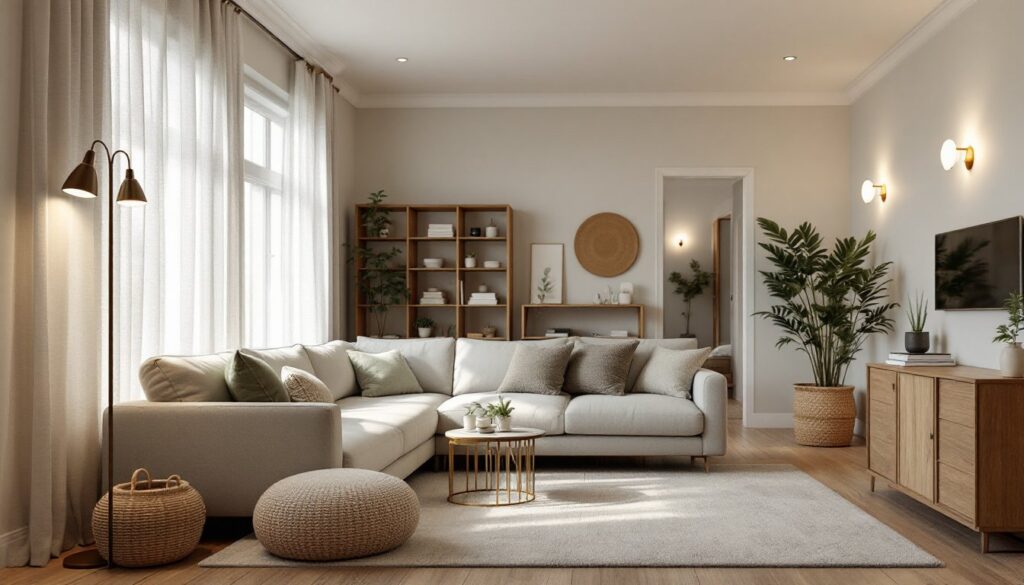
Incorporate living rooms with area rugs to define seating zones. A rug anchors furniture and visually groups pieces together, making the space feel organized and intentional rather than randomly scattered.
Color And Lighting Strategies For Balance
Color is feng shui’s most practical tool. Each color vibrates at a different frequency, and your room absorbs that frequency. Reds and oranges energize and warm. Blues and greens calm and refresh. Neutrals ground. The key is choosing a palette that supports the room’s purpose, yours is relaxation with enough energy for conversation and gathering.
Start with one dominant color for walls, then layer supporting colors through furniture and decor. A neutral beige or soft gray wall gives flexibility: add depth with deeper wood tones, muted greens (an earth-and-wood blend), or warm metallics. Avoid too much of the same shade, monotone rooms feel flat and draining. Even a mostly neutral room needs contrast and texture.
Lighting is equally critical and often overlooked. Harsh overhead fluorescents kill chi: they’re too uniform and exhausting. Aim for layered lighting: ambient (soft, overall light), task (for reading or activities), and accent (highlighting features). A combination of floor lamps, table lamps, and wall sconces gives you control over mood. Warm-toned bulbs (2700K color temperature) feel cozier than cool-white (4000K+). Dimmers are your secret weapon, they let you adjust energy throughout the day.
Windows and natural light matter hugely. Don’t block windows with heavy drapes unless you need privacy: light is the ultimate energy mover. Use sheer or light-filtering curtains to soften glare while keeping chi flowing. Mirrors amplify light and space, making the room feel bigger and more vibrant, place one opposite a window to bounce light deeper into the room.
Interior design for living rooms often overlooks how critical balanced lighting and color are to the overall feel. Get those right, and the room transforms.
Creating Zones And Defining Spaces Effectively
Even in an open-plan living room, you can create distinct zones for different activities: a seating zone for talking and relaxing, a reading nook, a workspace, maybe a play area. Zones feel more organized and intentional than a room that blurs everything together.
Define zones using rugs, furniture arrangement, lighting, or even subtle changes in height. A big rug for living rooms anchors the main seating area and tells your brain, “This is the gathering space.” A tall bookshelf can act as a room divider between a seating zone and a reading corner without blocking sight lines. Pendant lights over a side table signal a workspace or reading nook.
Each zone should feel complete but connected to the whole room. Don’t isolate them so much that the space feels fragmented: good feng shui is about flow and unity. When someone enters, they should sense the room’s rhythm, different areas with a clear purpose, not chaos.
The practical benefit? Zones keep things organized, reduce visual clutter, and help furniture serve a real function instead of just filling space. How to style a living room becomes easier when you’re designing zones rather than fighting to make a big, blank space feel cohesive.
Decluttering And Removing Stagnant Energy
Clutter is stagnant energy, full stop. Piles of magazines, forgotten knickknacks, cords, and things you don’t use block chi and make your brain tired. Feng shui starts with a ruthless edit: keep only what works functionally or brings you genuine joy.
Start by removing the obvious junk, broken items, duplicates, anything you’re holding onto “just in case.” Then move to the harder call: do you actually love that throw pillow, or does it just take up space? Does that side table serve a purpose, or is it a surface for stuff to accumulate? Be honest. An empty room with a few well-chosen pieces feels better than a crowded one with many forgettable ones.
For the pieces you keep, give everything a home. Books on shelves, remotes in a drawer, throw blankets folded neatly. When items have a place, your eyes rest instead of landing on scattered stuff. This isn’t obsessive, it’s about reducing visual noise so your nervous system can relax.
Storage is your friend. A woven basket under a side table, a cabinet for electronics, floating shelves for books, these contain clutter while adding design. Living rooms with wood floors especially benefit from intentional storage, because uncovered floors amplify visual noise.
Decluttering also applies to walls. Don’t cover every inch with art or photos: negative space is design too. A few pieces hung intentionally breathe better than a salon-wall gallery. Quality over quantity makes the space feel curated and calm, exactly what feng shui aims for.
The energy shift after decluttering is real. Rooms feel lighter, brighter, and instantly more inviting. Your guests will notice before they consciously understand why. Energize your living room starts with clearing out what’s draining it.